The Best Cleaning Schedule for Working Parents Is One You Can Keep
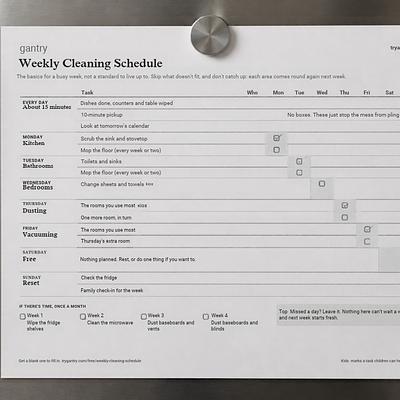
It's Thursday night. The kids are finally asleep, the lunches are packed, and you glance at the cleaning schedule you printed out on Sunday with real optimism. Monday: kitchen. Tuesday: bathrooms. Wednesday: dust, vacuum, mop, change the sheets, wipe the baseboards. Nothing after Monday is ticked. It isn't a plan any more. It's a list of what you didn't do.
Most cleaning schedules assume someone is home all day with time to spare. The best cleaning schedule for working parents assumes the opposite. It's the least that keeps a family house working, laid out so that a normal, busy week still counts as a success. This post gives you that schedule, the evidence for how often each job actually needs doing, and a free printable version for the fridge.
Why most cleaning schedules don't survive a working week
The typical schedule fails working parents in three predictable ways.
It assumes a whole day. "Saturday is cleaning day" works until the first birthday party, soccer tournament or sick kid. Then everything slides a week, and the next Saturday has twice as much to do.
It asks for everything, every day. A chart with daily boxes for dishes, laundry, floors and surfaces has more than 25 boxes before you reach the weekly jobs. A normal week leaves most of them empty, and empty boxes read as failure.
It's built on someone's ideal, not on guidance. Search for a cleaning schedule for working moms and you'll find charts that put the windows and the oven on a monthly rotation. The cleaning industry's own guidance is gentler than that: twice a year for windows, every few months for the oven (more on the numbers below).
The fix isn't more discipline. It's a smaller schedule that has room for the week you actually have.
The schedule: good enough on purpose
Here's the whole thing. It takes about 15 minutes a day on weekdays, leaves Saturday free, and has a short reset on Sunday.
Every day (about 15 minutes, no boxes)
- Dishes done, counters and table wiped
- A 10-minute pickup (kids can help)
- A look at tomorrow's calendar
These have no boxes on the printable on purpose. They're the small things that stop mess from piling up, and there's nothing to fall behind on.
One small job each weekday
Day | Area | Tasks |
|---|---|---|
Monday | Kitchen | Scrub the sink and stovetop; mop the floor (every week or two) |
Tuesday | Bathrooms | Toilets and sinks; mop the floor (every week or two) |
Wednesday | Bedrooms | Change sheets and towels |
Thursday | Dusting | The rooms you use most; one more room, in turn |
Friday | Vacuuming | The rooms you use most; Thursday's extra room |
Two tasks at most. On a good day you'll finish in ten minutes. On a bad day, skip it.
Dusting and vacuuming the whole house every week is a big job, so the schedule doesn't ask for it. Each week, dust and vacuum the rooms your family uses most. Which rooms those are depends on your home: for one family it's the kitchen and living room, for another it's the entry and the kids' rooms. Then add one more room in turn, a bedroom or any room that missed out, and do the same room on both days. Over a few weeks every room gets its turn. If someone in the house has allergies, do their bedroom every week.
Mopping can slip too. If the kitchen or bathroom floor looks fine, leave it for next week.
It also helps to use each evening's pickup to get ready for the next day's job: Thursday's pickup clears the floors, so Friday's vacuuming goes faster.
Saturday: nothing planned
Rest, or do one thing if you want to. A free day is part of the schedule, not a gap in it.
Sunday: a short reset
- Check the fridge: eat or freeze what's close, and toss leftovers older than 3–4 days
- A five-minute family check-in on the week ahead: who has what, and what got skipped
The one rule: don't catch up
If a day gets missed, leave it. Nothing on this list can't wait a week, and next week starts fresh.
If there's time, once a month
Pick one a week: wipe the fridge shelves, clean the microwave, dust the baseboards and vents, dust light fixtures and blinds. If the month gets away from you, they'll keep.
How often should you really clean each part of the house?
This is where the schedule comes from. For each area, here's what the guidance says, from the American Cleaning Institute (ACI), Cleveland Clinic, the Asthma and Allergy Foundation of America (AAFA), the American Academy of Allergy, Asthma & Immunology (AAAAI), and Consumer Reports, plus what's enough when the week is tight.
Kitchen counters, table and dishes
Guidance: daily, after meals. The ACI's home cleaning routine says to wipe kitchen counters and tables after meals and run the dishwasher. If the week is tight: the same. This is the one place where daily really is the minimum, because crumbs and spills attract pests.
Stovetop and sink
Guidance: wipe after use, and scrub the sink at least once a week. Consumer Reports suggests wiping cooking surfaces after each use. If the week is tight: a proper scrub once a week, which is Monday on the schedule.
Bathroom
Guidance: weekly for toilets, sinks, the shower and the tub (ACI, Consumer Reports), and mop the floor weekly (AAAAI; TODAY's cleaning checklists). If the week is tight: toilets and sinks weekly, which is Tuesday on the schedule, the floor every week or two, and the shower when you can see it needs it. Clean more often while anyone in the house is sick.
Sheets and towels
Guidance: wash sheets at least once a week, per Cleveland Clinic dermatologists and the ACI, or every 3–4 days if pets sleep in the bed (Sleep Foundation). Wash bath towels at least weekly, and 2–3 times a week in a humid house (Cleveland Clinic). If the week is tight: sheets and towels together once a week, which is Wednesday on the schedule. If sheets slip to every other week now and then, put the kids' beds first.
Floors: vacuuming, sweeping and mopping
What sources say: it depends on the floor and how much it's walked on.
- Carpet and rugs: for people with allergies, the American Academy of Allergy, Asthma & Immunology (AAAAI) says to vacuum carpet weekly with a HEPA or small-particle filter and wash small rugs and mats weekly.
- Hard floors: AAFA suggests vacuuming once or twice a week, and the AAAAI says to mop hard floors, including the kitchen, weekly.
- Kitchen and bathroom floors: mop weekly (AAAAI; TODAY's cleaning checklists), plus a quick spot-clean after spills. Vacuum or sweep first, so the mop doesn't push grit around.
If the week is tight: vacuum the rooms you use most every week, and let the rest take turns, as above, so each gets done every few weeks. Mop the kitchen and bathroom floors every week or two, and wipe up spills as they happen. Allergies or shedding pets are a reason to vacuum the busiest rooms twice a week, and to do the allergic person's bedroom every week.
Dusting
Guidance: reachable surfaces every week or two, and high spots like the tops of bookshelves about once a month (Consumer Reports). AAFA suggests weekly with a damp cloth for people with allergies. Baseboards, vents, light fixtures and blinds collect dust slowly; guidance ranges from weekly to a yearly deep clean, and about monthly is a reasonable middle (ACI, TODAY, Consumer Reports). If the week is tight: dust the rooms you use most weekly, and the rest when their turn comes round. Baseboards, vents, light fixtures and blinds go on the monthly row.
The fridge
Guidance: clean out the fridge weekly (ACI), and eat or throw out leftovers within 3–4 days (Cleveland Clinic, citing the USDA). If the week is tight: a two-minute look on Sunday, and wipe the shelves about once a month. If meal planning is the bigger struggle, this guide to family meal planning helps.
Oven, microwave and windows
Guidance: clean the oven thoroughly every 3–6 months, or monthly if you roast a lot (Consumer Reports, quoting Whirlpool). Wipe the microwave after spills and give it a proper clean about monthly. The ACI's Jessica Ek suggests washing windows twice a year, in spring and fall. If the week is tight: these belong on a seasonal list, not a weekly one. The less frequent jobs, like the fridge coils, the dryer vent and the gutters, are in the household maintenance schedule.
Sharing it: partners, kids and the Who column
A cleaning schedule on the fridge does something a schedule in one person's head can't: it shows everyone what the house needs, without anyone having to ask.
- Put a name next to every task. The printable has a Who column for this. A task with no name next to it ends up with whoever usually notices. It's the same way one person becomes the default parent, the one everyone turns to first about the kids: nobody agrees to it, it just lands on them.
- Give kids real jobs, not points. The pickup, dusting, and changing sheets and towels are all within reach for most school-age kids. Skip the sticker charts. It's their part of the house, not a game they can lose.
- Use the Sunday check-in. Five minutes to look at what got skipped and who has what next week is enough. It's also where you notice that one person keeps ending up with everything.
If the bigger problem is everything around the cleaning (noticing what needs doing, deciding when, remembering to ask), that's mental load, and these 11 ways to reduce mental load can help.
What to do when you fall behind
You will fall behind. Every family does. Here's how to keep it from snowballing.
- Don't catch up. If Tuesday's bathroom didn't happen, it happens next Tuesday. Doubling up is how schedules collapse.
- Protect the daily basics. Dishes, counters and a quick pickup keep the house livable, even when nothing else gets done.
- Keep the two non-negotiables. Clear out leftovers older than 3–4 days, and clean the bathroom more often when someone is sick. Everything else can wait.
- Shrink the list. If a week keeps breaking, drop a task rather than push harder. A schedule you keep beats a better one you don't.
Get the free printable
The free printable house cleaning schedule has everything above on one landscape page for the fridge: the daily basics, one small job for each weekday, a free Saturday, the Sunday reset and the monthly jobs, with a Who column for names. There's also a blank version to fill in your own plan, and both download without an email.
When paper isn't enough
A schedule on the fridge is great for the weekly rhythm. It can't move things when someone's away, it doesn't know about the dentist or the furnace filter, and you can't check it from work.
That's what I'm building Gantry for: the weekly rhythm and the less frequent jobs in one place, shared with the people you run the house with, and quiet unless something actually needs you. If that sounds useful, you can join the waiting list.
For more on keeping a household running without carrying it all yourself, browse the household management posts.
Frequently asked questions
- What's the best cleaning schedule for working parents?
- One that's small enough to keep in a busy week: about 15 minutes of daily basics, one small job on each weekday, a free Saturday and a short Sunday reset. If a day gets missed, skip it rather than catching up.
- How often should you clean your bathroom?
- Clean toilets and sinks weekly, and the shower and tub weekly or when they need it. That's the guidance from the American Cleaning Institute and Consumer Reports. Clean more often while someone in the house is sick.
- How often should you dust your house?
- Dust reachable surfaces every week or two, and high spots like the tops of bookshelves about once a month. People with allergies benefit from weekly dusting with a damp cloth.
- How do you keep a house clean with a full-time job and kids?
- Spread small tasks across the week instead of saving everything for one day, give every task a named owner, including the kids, and lower the bar to what keeps the house working. A short weekly check-in catches what slipped before it piles up.
Stay on top of what matters
Join the waiting list for early access to Gantry, plus a personal discount code.