Default Parent Meaning: What Is a Default Parent, and How Do You Share the Role?
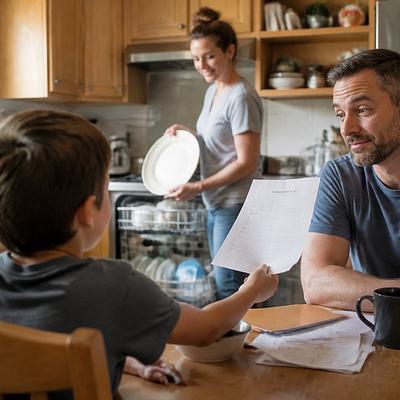
It's 7:40 on a school morning. Both parents are in the kitchen. One is unloading the dishwasher; the other is pouring cereal. A child walks in and asks, "Where are my shoes?" They ask the parent pouring cereal. They always ask that parent. Nobody decided this. It just is.
That's the default parent meaning in one scene: the default parent is the one everyone turns to first. The one the school calls, the one kids wake up at 2 a.m., the one who knows the shoe size, the pediatrician's number and which permission slip is due Friday. The other parent may be loving, involved and doing plenty of work. But when a question about the kids comes up, the answer defaults to one person.
If you've ever felt like you're "on" every hour of the day even when your partner is home, this is probably what you're feeling. Here's what the term means, how to tell whether you're the default parent, why it happens even in couples who meant to split everything evenly, and what actually helps share the role.
What is a default parent?
A default parent is the parent who carries primary responsibility for the children's needs, usually without anyone formally agreeing to it. "Default" is the important word. It's not about who does more tasks on a given day. It's about who is assumed to be in charge when nobody has said otherwise.
That assumption shows up from every direction:
- Kids go to the default parent first, for snacks, comfort, lost things and permission.
- Schools, doctors and coaches call or email the default parent, even when both parents are listed.
- The other parent asks the default parent rather than finding out themselves: "What time is pickup?" "Does she have practice today?"
- The default parent assumes it too. They keep tracking, because if they stop, they've learned that things fall through.
The role isn't tied to gender, employment or who earns more, although in a lot of households it lands on mothers. It can belong to a working parent or a stay-at-home parent, and it can shift over time, for example after a new baby, a job change or a move.
Signs you're the default parent
You don't need a test to know, but naming the specific signs makes the pattern easier to talk about. You're probably the default parent if:
- You're the first contact on every school, daycare and medical form, and nobody has ever asked whether that should change.
- Your kids walk past your partner to ask you something.
- You know the answer to "What do we need for tomorrow?" without checking anything.
- When you're away for a weekend, you leave a list, a schedule, or a long voice note before you go.
- Your partner "helps" with the kids, and you're the one who says what help is needed.
- You notice when the kids are running low on clothes that fit, when a checkup is due, or when a birthday party invitation hasn't been answered.
- Being off duty doesn't feel possible, even when someone else is technically watching the kids.
That last one is the clearest sign. A default parent can hand off a task, but not the responsibility for remembering that the task exists.
Default parenting day to day: it's mostly invisible work
Default parenting isn't only the visible jobs like school runs, bath time and packed lunches. Those are real, and they're often shared. The heavier part is the work around them: noticing what needs doing, planning it, deciding, and checking that it happened.
Sociologist Allison Daminger describes this "cognitive labor" in four parts: anticipating needs, identifying options, deciding between them, and monitoring the results. Most couples split the deciding fairly evenly. The anticipating and monitoring, the parts that never end, tend to fall to one person. That person is usually the default parent.
Here's how it looks in a normal week:
- Anticipating: realizing the kids' swim lessons end next month and the next session fills up fast.
- Identifying: finding three options for after-school care that fit both work schedules.
- Deciding: talking through which one with your partner. (This is often the only part the other parent sees.)
- Monitoring: making sure the form got sent, the deposit got paid, and the first day is on the calendar.
This is the same mental load in relationships that many couples argue about without having words for it. Default parenting is that mental load, focused on the kids.
The default parent problem: why it becomes a problem
Plenty of families have one parent who handles more of the kid logistics, and it works for them. The default parent problem starts when the role is unchosen, unacknowledged and never off.
A few things make it wear people down:
- It's constant. Tasks have an end. Being the person who keeps track of everything doesn't, so the default parent rarely gets a real break, even on vacation.
- It's invisible. When the default parent does the job well, nothing goes wrong, and so nothing looks like it took effort.
- It's self-reinforcing. The more one parent knows, the more sense it makes to ask them, and the less the other parent learns. After a few years, the gap feels like a fact about personalities rather than a habit you both fell into.
- It breeds resentment on both sides. One parent feels alone in the work. The other feels criticized for help they didn't know was needed.
None of this means the other parent doesn't care. Usually they just never had to hold the whole picture, because someone else always did.
How to share the default parent role
The goal isn't a perfect 50/50 split of every task. It's that both parents can be the default for something, and that the household doesn't depend on one person's memory. These steps tend to work better than an argument about who does more.
1. Make the invisible work visible
Before you can share the load, you both need to see it. Write down everything the default parent tracks for the kids: appointments, school forms, clothes sizes, activity sign-ups, birthday gifts, who's picking up on which day. Do it together, and let the other parent add what they know. A list gives you a place to start from, and it's usually much longer than either of you expected.
2. Hand off whole areas, not single tasks
"Can you pick up the kids on Thursday?" shares a task. "You own after-school activities" shares a role. When one parent owns an area completely, including the remembering, planning and following up, the other parent can actually stop thinking about it. Good areas to start with are ones with a clear boundary, like medical appointments, one child's sports, or school forms.
3. Change the defaults outside the house
Swap the first contact on forms for the areas the other parent now owns. Tell the coach or the school office. Let calls go to the owner. It feels small, but the outside world is half of what keeps the role in place.
4. Let the new owner do it their way
If you hand off swim lessons and then check every detail, you still own swim lessons. The new owner will do some things differently, and a few things may slip at first. That's part of the handoff, not proof it doesn't work.
5. Keep it in a shared place, and look at it together
Most default parents keep the household in their head, because that's the only place it fits. Moving it into something you both use, whether that's a shared calendar, a whiteboard or an app, means the information doesn't live with one person. A short weekly check-in, where you look at the coming week together and settle who's covering what, keeps the handoff from quietly drifting back.
For more ways to lighten what's left, including automating bills and building routines, see how to reduce mental load.
You don't have to be the default for everything
Being the default parent often starts out as love and competence. You noticed, so you handled it, and you were good at it. It's not a failure that it ended up with you. But it can be undone, a piece at a time, by moving whole areas of family life out of one person's head and into a place both parents can see and own.
That's what I'm building Gantry to do: give the recurring work of running a family one shared home, so both parents can see what's coming, who owns what, and what's already handled. If that sounds useful, you can join the waiting list. For more on sharing the invisible work of running a household, browse the mental load posts.
Frequently asked questions
- What does default parent mean?
- The default parent is the parent everyone turns to first for anything about the kids: the children, the school, doctors and often the other parent. It's usually an unspoken role rather than an agreed one, and it carries most of the planning and remembering behind family life.
- What are the signs you're the default parent?
- Common signs are being the first contact on every form, kids asking you before your partner, knowing what everyone needs tomorrow without checking, and leaving detailed instructions whenever you're away. The clearest sign is never feeling off duty, even when someone else is with the kids.
- Is default parenting the same as mental load?
- They overlap. Mental load is the invisible work of anticipating, planning and keeping track of everything a household needs. Default parenting is that mental load focused on the children, plus the expectation from everyone else that one parent will handle it.
- How do you stop being the default parent?
- Make the invisible work visible first by listing everything you track. Then hand off whole areas, such as medical appointments or one child's activities, rather than single tasks, change the first contact on forms for those areas, and review the week together so the handoff sticks.
Stay on top of what matters
Join the waiting list for early access to Gantry, plus a personal discount code.